
BEARINGS & BUSHINGS
LONGER LASTING HARDER WORKING
WHY POLYGON COMPOSITE BEARINGS?
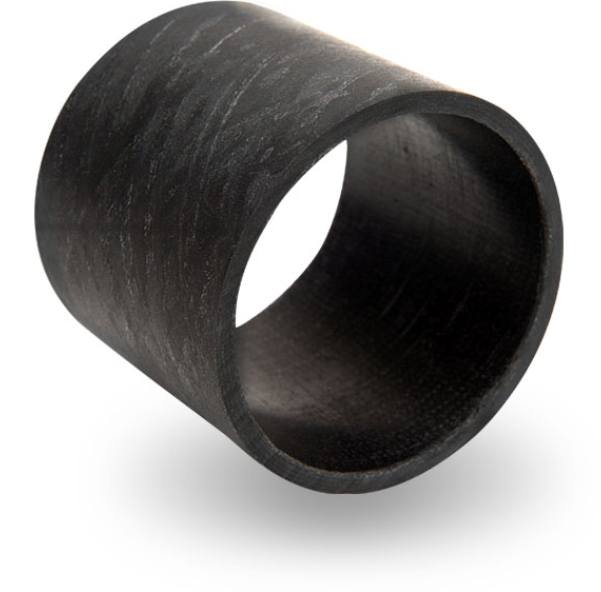
Tailored to meet your design and performance needs, Polygon’s PolyLube® bearings are reinforced greaseless bearings that provide strength and performance. They are ideal for replacing traditional metal bearings because they last longer and can save you money over time.
KEY BENEFITS
MADE FOR YOU, SO YOU CAN MAKE MOVES
Maintenance-free bearings help improve productivity
Corrosion resistance for dry and/or wet environments
Resistance to impact fatigue means a longer service life
A flexible design allows for an optimized performance tailored to you
Lower bearing, lubrication system and maintenance costs
Performance stability across a wide range of temperatures
Can take on high load capacities, meaning a broader range of jobs
SPECIFICATIONS
Our engineers will assist your team in determining the best fiber architecture, resin formulations and finishing for your ideal application. Your chosen composite construction can allow for these features in your bearings:
- Maintenance-free. True self-lubrication with unique wear surface options.
- Lower total cost of operation (TCO). Eliminate zerks, grease costs, pathways in pins and castings and maintenance labor cost.
- Design Flexibility. High strength. Light weight. Large or small size.
- Thin or thick walls. Low coefficient of friction, coupled with high loadbearing capacity.
- Long service life. Testing shows wear under 0.15mm after 1.6 million cycles.
- Resistance to impact fatigue and cavitation problems.
- Higher operating temperature range -325° to 325°F.
- Bushing selections for wet and submerged applications, reliability in contamination, high frequency, low oscillation, etc.
- Machined holes, cutouts and more.
ENGINEERED APPLICATIONS
MRP Bearing
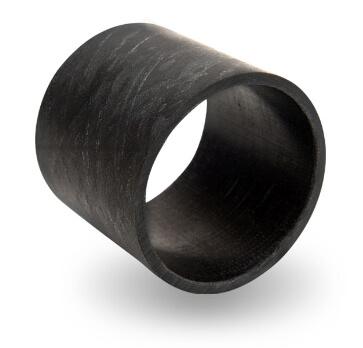
The MRP Bearing is a highly versatile composite bearing for applications that require high load capacity, low frictional values, along with minimal wear characteristics.These bearings excel in highly loaded bearing joints where a long lifespan and low maintenance is important. A few example applications include; agricultural equipment such as foraging and harvesting machinery, material handling equipment, earth-moving equipment, construction vehicles, airport ground transport equipment and more. Plus, MRP bearings have extremely low water absorption rates and are well designed for wet and submerged applications.
Polygon’s most popular bearing choice, the MRP Bearing has a unique, embedded material that adds lubrication to decrease the initial coefficient of friction. Upon initial actuation, it addresses issues of intermittent stick-slip or noise generated in certain lightly loaded joints. Designed to minimize bearing wear, the MRP Bearing decreases friction and virtually eliminates the typical break-in period. With intermittent rotation or oscillation, radial wear on the MRP Bearing is negligible over thousands of hours of run-time.
EWS Bearing
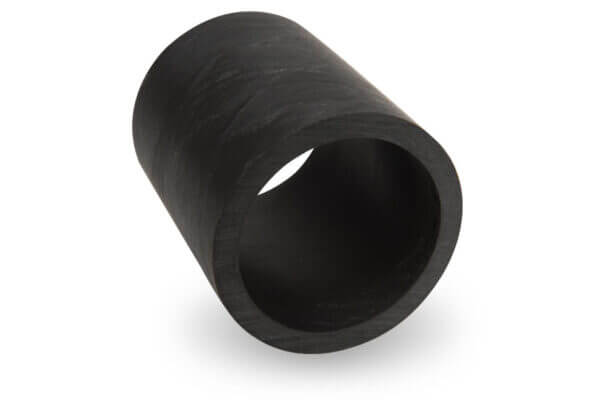
Polygon’s Extended Wear Surface (EWS) is made for high cycle and dithering, and low frictional values. It’s excellent for use in heavy equipment such as in construction, agriculture, mining, lifts and other rigorous equipment applications. Capable of going extended periods without maintenance, EWS resists contamination and wear.
The EWS bearing provides these benefits:
- Maintenance free, never needs greasing
- Use in high capacity, low friction conditions
- Reliability and predictability.
- No grease, means no dirt contamination
- Maintenance-free operation for long time periods
- Reduced maintenance visits
- Preservation of equipment uptime.
- Wear resistance and reliability in contaminated joint locations
- Elimination of seals and machining costs
EWS has increased wear resistance and reliability in contaminated joint locations with small design envelopes. Seals and their machining cost can oftentimes be eliminated thanks to the increased contaminated environment performance.
Polylube® Glass Tape Bearing
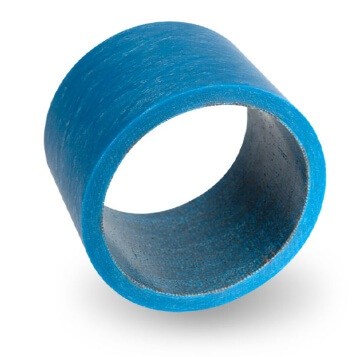
Glass Tape wear surface provides reduced stick slip and smooth motion, especially in lower pressure applications. A great example of this is when the bearing movement is primarily axially (along the length of the bearing), such as in cylinder guide rod bearings. Use it in a bearing that will perform at a moderate RPM for applications with higher surface velocities or when mixed film conditions are desired. Glass Tape is manufactured by a filament winding process that results in a continuous fiberglass filament backing composition, which ensures excellent mechanical properties, especially fatigue resistance.
Applications for PolyLube Glass Tape Bearings range from guide rod bearings to linear motion components to hydraulic pumps. The PolyLube bearing offers a more elastic, damage tolerant structure when compared to traditional metallic bearing materials. In addition, the Glass Tape bearing exhibits good cavitation resistance when subjected to high pressure fluids during cyclic conditions.
“With Polygon, there is an ease of collaboration and communication. Additionally, their material technology is good. I’ve seen other PTFE bearings where the adhesives were not fully validated, but everything we’ve seen from Polygon has met or exceeded our expectations.”