
Frequently Asked Questions (FAQs)
Your top questions answered—everything from material performance and design
considerations to production processes and sustainability.
Introduction to Composites (101)
How are your products made?
Depending on the product we’re making, Polygon Composites are made in one of the following ways:
Filament wound: The fibers are dipped in resin, wound around a mandrel, then moved to the ovens to bake.
Braided: The fibers are wound around each other in a braid, and then the whole braid is dipped in resin.
Pultruded: The fibers are pulled, wound, and heated simultaneously.
What materials are used to create composite bearings, bushings, and tubing products?
Polygon Composite bearings/bushings and tubing are made using continuous fiberglass thread, resin, and heat.
Why would I use a composite bearing, tubing, or cylinder product?
We like to say that if you’re looking to make your life easier and your equipment perform at its best for longer, you should consider composite. Polygon Composite products can handle high pressure, high heat, the most exacting sizes and specifications, virtually eliminate maintenance, and stand up to rust and corrosion throughout their lifetime.
What are the key benefits of using a composite solution?
Composite bearings/bushings and tubing can transform the way your equipment works, how long it lasts, and how much (or how little) maintenance it requires.
Some key benefits are:
- Remarkable customization
- Stronger and lighter than traditional materials
- Can be designed for thick- or thin-walled applications
- Durable and corrosion/rust-resistant
- Elevated temperature performance
- Nonconductive and nonmagnetic without the need for extra insulation
What materials can be replaced with a composite solution?
Composite bearings/bushings and tubing can replace virtually any other solution, especially metal, plastic, and carbon fiber.
What's the difference between a bushing and a bearing?
The short answer is that they’re the same thing. The terms “bearing” and “bushing” are often used interchangeably and can vary depending on where you are in the world. Both bearings and bushings are parts that support a shaft that rotates inside a piece of machinery. Our composite bearings and bushings are made to be maintenance-free forever and extend the life of your equipment.
Why shouldn't I use a composite product?
While our products perform extremely well in a wide variety of applications, there are some instances in which you might choose another material.
In medical tubing:
If the application is very simple and won’t require multiple lumens or special shapes and/or won’t be used in electrical/energized applications, composite might not be price competitive. Also, if you need maximum flexibility vs. rigidity, you might choose another material.
In bearings/bushings:
Like all bearings, Polygon composite bearings operate under certain ranges of pressure, velocity, and speed while remaining maintenance-free. Outside of those ranges, the composite may incur damage over time. The more our engineers know about the demands of your application, the better they can design the right solution for you.
In cylinder tubing:
While we can offer design in significant weight savings along with corrosion and rust prevention, there are situations in which composite may be heavier than other alternatives.
How does fiberglass compare to carbon fiber?
Composite (fiberglass) is more resilient in shape than carbon fiber, which can crack or break under pressure or when bent. Composite can be a better choice for medical tubing because it is biocompatible, whereas carbon fiber is not. Composite can also beat carbon fiber in cost, partially because carbon fiber production is more intense than composite. Carbon fiber beats most materials in terms of high strength.
What are the maximum loads for a composite solution?
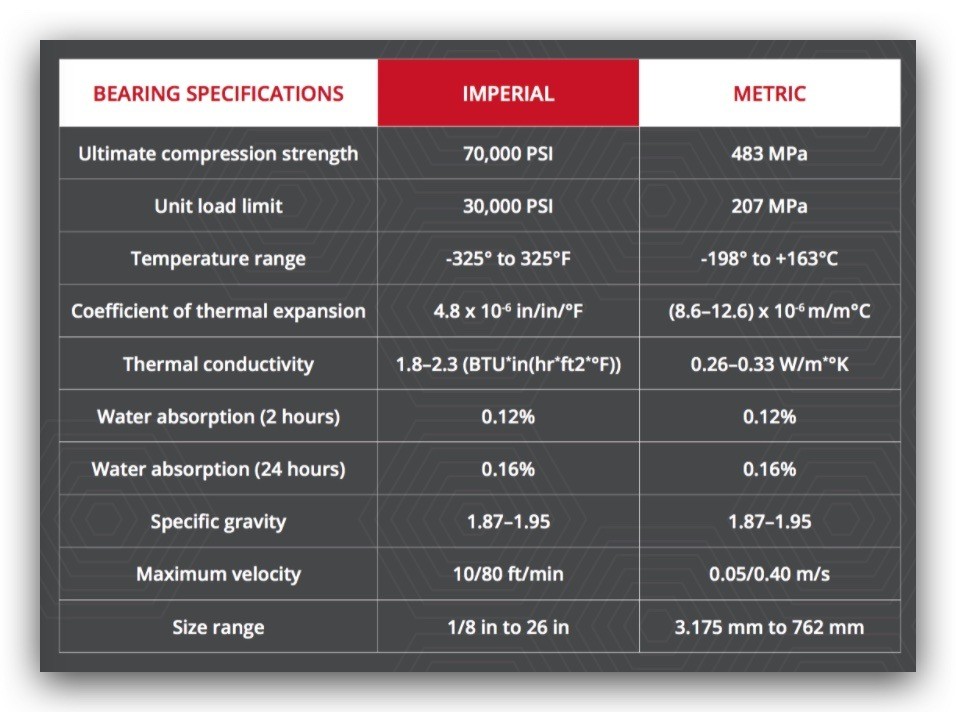
As with any material, load capacity varies based on product size and its location in your equipment. Use the following table to assess bearing specifications and download our Bearings Design Guide for more information.
How many cycles can a composite product withstand?
We test our bearings to a variety of specifications including weight, thickness, and oscillation angle. For example, testing of our MRP PolyLube® bearing at 22,500 pounds, with 50° oscillation angle, resulted in stable wear under 0.005” at more than 1.5 million cycles. Download our Bearings Design Guide for more specifications and information.
How do your products handle contamination?
Polygon Composite bearings are naturally resistant to contamination and wear. And since they never require grease, grease contamination is minimized or eliminated altogether.
Do you have to grease your materials in their application and use?
No. Polygon Composite products are self-lubricating and never require grease.
What is a bushing?
A bushing is a hollow, short tube that’s used to reduce friction between moving parts in a piece of equipment. Bushings fit within rotating or sliding shaft components, which is why the fit and specifications are so important.
What is a bearing?
A bearing (also known as a plain bearing) is the same thing as a bushing. The terms are often used interchangeably and usage changes depending on where you are in the world. A bearing is a hollow, short tube that’s used to reduce friction between moving parts in a piece of equipment. Bearings fit within rotating or sliding shaft components, which is why the fit and specifications are so important.
Testing
How do you test your products and what tests do you recommend before implementing a composite solution?
Our first goal is to make sure we engineer our products to your exact specifications, so that whether we test their performance, or you do, they live up to and exceed your standards. If we know the test method you’ll be implementing, we can often mirror it in our facility before delivering the final product to you.
Outside of your specific project, we test our products’ temperature ranges, voltage tolerances, chemical reactions, pressure, and water. We also test our medical tubing to ISO- 10993 for biocompatibility.
How do you handle composite product prototypes?
Since most of our products are created for custom applications, our prototypes can be very specific. As part of our innovation pipeline, we regularly create derivatives of our standard products and work to maximize lifespan, load capacity, tolerances, cost efficiency, and more. If you’re interested in seeing samples of our bearings, request a bearings sample kit here. If you’re interested in seeing samples of our medical tubing, request a medical sample kit here.
How long should bench testing a new application take?
On average, testing takes 9 months with an existing customer and 27 months with a new customer. During this time, we collaborate with you to make sure we understand all the parameters, and how success and failure is defined.
How long should field testing a new application take?
Field testing can take longer to dictate and start implantation, but once that’s done, the average testing window is the same as bench testing: 9 months for existing customers and 27 months for new customers.
Solution-Specific
Bearings
What materials are bearings commonly made from?
Traditional bearings/bushings are made of different types of metal or plastic. Polygon Composite bearings/bushings are made from a mixture of fiberglass, resin, and heat. To compare Polygon Composite bearings/bushings to metal, check out our Comparison Page.
Where are composite bearings and bushings most commonly used?
A bearing is used anywhere there is a housing and a pin. Polygon Composite bearings/bushings are widely used by leaders in construction, agriculture, medical, electrical, marine, and oil & gas equipment, as well as aerial lifts, material handlers, work & haul trucks, and pneumatic & hydraulic cylinders.
How do you make a composite bearing or bushing product?
Depending on the product we’re making, Polygon Composite bearings are made in one of the following ways:
Filament wound: The fibers are dipped in resin, wound around a mandrel, then moved to the ovens to bake.
Braided: The fibers are wound around each other in a braid, and then the whole braid is dipped in resin.
What materials are used in your composite bushings and bearings?
Polygon Composite bearings/bushings are made using continuous fiberglass thread, resin, and heat.
What is a self-lubricating bearing?
Composite bearings don’t experience or cause the same friction as traditional bearings, so they don’t require grease or lubrication – ever. This reduces maintenance time, effort, and costs, and extends the life of your equipment.
How does a composite bearing compare to a bronze bearing?
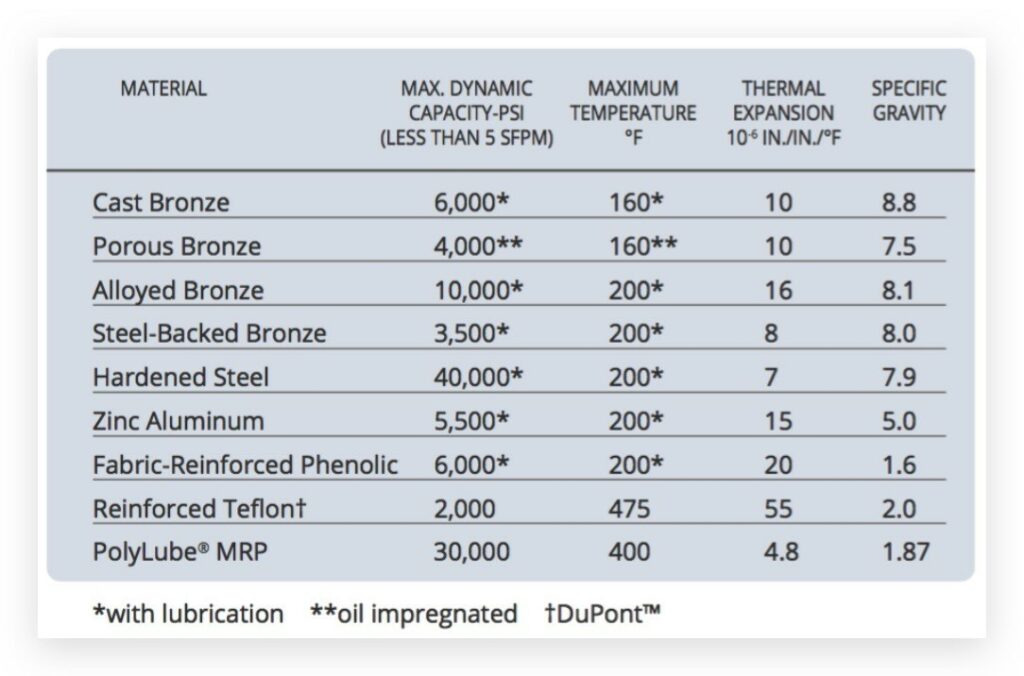
Use this chart as a quick comparison of PolyLube® bearings to bronze, steel, aluminum, fabric-reinforced phenolic, and reinforced Teflon. Greased metal-backed bearing materials have very limited operating temperature ranges. They traditionally span from -40° to +210°F compared to PolyLube ranges from -325° to 400°F.
How does a composite bearing compare to an engineered plastic bearing?
There are many different types of plastic bearings, but we’ll focus on two: Nylon and Injection-molded plastic.
Nylon naturally absorbs water much faster than resin (used in composite bearings). While the difference in water absorption with a composite bearing is minimal after one hour vs. 24 hours, the difference with a nylon bearing is much greater. If your application will include water, composite is a more durable choice.
Injection-molded plastics can be produced quickly and affordably. Protective materials like Teflon are dispersed throughout the bearing. In Polygon composite bearings, fibers are strategically placed according to stress points and motion. That means our composite bearings can last two to three times longer than injection-molded plastic bearings.
Do you have to grease a composite bearing application?
No. Polygon Composite products are self-lubricating and never require grease.
What maintenance is required with composite bearings and bushings?
None. Once we custom engineer your composite bearings to fit perfectly in your equipment, you do not need to maintain them.
What's the maximum load a composite bushing can bear?
As with any material, load capacity varies based on product size and its location in your equipment. Use the following table to assess bearing specifications and download our Bearings Design Guide for more information.
How many cycles will a composite bearing/bushing withstand?
We test our bearings to a variety of specifications including weight, thickness, and oscillation angle. For example, testing of our MRP PolyLube® bearing at 22,500 pounds, with 50° oscillation angle, resulted in stable wear under 0.005” at more than 1.5 million cycles. Download our Bearings Design Guide for more specifications and info.
How do I know how long a composite bearing will last in my product?
When designed correctly, composite bearings can outlive the equipment itself. Our customers have disassembled their equipment and found the Polygon bearings inside had hardly any wear.
Do you have specific examples of composite bearing applications?
Polygon Composite bearings/bushings are widely used by leaders in construction, agriculture, medical, electrical, marine, and oil & gas equipment, as well as aerial lifts, material handlers, work & haul trucks, and pneumatic & hydraulic cylinders.
Medical Tubing
What is medical tubing?
Medical tubing is used to connect medical devices and robotics from patient to operator. Polygon initially started making medical tubing for laparoscopic prostate procedures in the 1980s when a customer inquiry arrived requiring rigid composite tubing to insert up the urethra. Today, we’re a proven leader in composite medical tubing that withstands the strain of fast starts and provides protection against short-circuits.
How are composite medical tubing products made?
All Polygon medical tubing is made using pultrusion in varied fiber orientations, including unidirectional, circumferential, and braided. The fibers are pulled, wound, and heated simultaneously.
For more information on the benefits of each fiber orientation, check out our Medical Design Guide.
What are the most common applications for composite medical tubing products?
Polygon medical tubing is most commonly used in minimally invasive products such as ablation tools, robotic surgery, endoscopic/laparoscopic devices, and suction/irrigation devices. See more in our Medical Design Guide.
Are composite solutions safe to use in a medical application?
Yes! All Polygon medical tubing is ISO- 10993 certified, safe inside the body for up to 24 hours. It’s also self-insulating, which protects both patients and operators from risk of shock.
Advanced Tubing
What materials are used in advanced tubing applications?
Polygon Composite bearings/bushings and tubing are made using continuous fiberglass thread, resin, and heat.
Why should I use a composite tubing product?
We like to say that if you’re looking to make your life easier and your equipment perform at its best for longer, you should consider composite. Polygon Composite products can handle high pressure, high heat, the most exacting sizes and specifications, virtually eliminate maintenance, and stand up to rust and corrosion throughout their lifetime.
Do you have ready-made products waiting to be applied, or is every composite advanced tubing product custom made to order?
While we always keep raw materials on hand, actual cylinder products are usually made to your exact specifications. The better we engineer your tubing at the beginning, the longer life it will have in your equipment or application.
Cylinder Tubing
What is cylinder tubing?
Cylinder tubing is placed around hydraulic or pneumatic rods to keep pistons in place and intact.
Where do you most commonly apply a composite cylinder tubing product?
Polygon composite cylinder tubing is used for everything from couplers in industrial underwater plumbing equipment to tree cutting equipment. Because couplers are often underground or inside equipment, replacing them can be time-consuming and costly. Polygon composite cylinders are naturally rust and corrosion-resistant, and last for the long-haul. Other common applications include: fifth wheel air releases, valves, actuators, pumps, and shock absorbers.
How are cylinder tubes made?
All Polygon cylinder tubes are filament wound. The fibers are dipped in resin, wound around a mandrel, then moved to the ovens to bake. This produces the best long-lasting strength and impingement resistance without adding weight.
Why should I use a composite cylinder tubing product?
Key benefits of Polygon composite cylinder tubing include:
- Lighter weight
- Impingement resistance
- Corrosion resistance
- Low friction
- Design flexibility
- Dielectric insulation
- Low thermal conductivity
Find more features, full specifications, test results, and more in our Cylinder Design Guide.
Do you have ready-made products waiting to be applied, or is every composite cylinder tubing product custom made to order?
While we always keep raw materials on hand, actual cylinder products are usually made to your exact specifications. The better we engineer your tubing at the beginning, the longer life it will have in your equipment or application.
Are cylinders always filament wound?
Polygon cylinders are always filament wound for long-lasting strength.
Dielectric Tubing
What is dieletric tubing?
Dielectric tubing is typically used as a sleeve within the armatures of electric motors. This secondary layer of insulation protects electrical tool operators from shock and eliminates the need for grounding the unit.
How are composite dielectric tubing products made?
Polygon composite dielectric tubing is made using a technique called braiding. The fibers are wound around each other in a braid, and then the whole braid is dipped in resin.
What are the most common applications for composite dielectric tubing products?
Composite dielectric tubing can be used in any equipment with an AC motor. The tubing acts as a ground wire, eliminating the need for a three-prong cord or additional grounding wire. Polygon Tube is typically used to protect electrical tool operators from shock.
Why is using a dielectric material important in medical tubing applications?
Dielectric tubing is an important part of minimally invasive surgical tools for procedures like ablation, in which tissue is removed from blood vessels. Without dielectric tubing, these procedures would be much more invasive for patients. Composite tubing ensures patients and operators are protected from shock while using these tools.
Are composite solutions safe to use in a medical application?
Yes! All Polygon composite medical tubing is ISO-10993 certified and safe inside the body for up to 24 hours.
Industry-Specific
Construction
What are the most common applications for a composite product in construction?
Common applications for Polygon composite tubing in construction include excavators, mini and micro excavators, bulldozers, backhoes, skid steers, wheel loaders, mining equipment, articulating joints, cylinder base and rod ends, and cylinder movement pivot points.
What kind of load capacities can a composite bearing or bushing handle on construction equipment and machinery?
As with any material, load capacity varies based on product size and its location in your equipment. Use the following table to assess bearing specifications and download our Bearings Design Guide for more information.
Where are composite material solutions most effective when used in construction equipment?
Polygon composite bearings and tubing are perfect for the following applications:
- When self-lubrication is required
- When bearing neglect could lead to product liability claims or premature failure
- When maintenance costs need to be closely monitored
- When back-slip conditions exist
- When high load capacities are needed
- When resistance to chemical, galvanic, or fretting-related corrosion is a problem
- When galling and scoring need to be minimized
- When electrical insulation is required
How do composite material bearings, bushings, and tubes handle exposure to the elements, as compared to metal applications?
Polygon bearings/bushings and tubing are designed to stand up to the harshest of environments. Our products are naturally corrosion- and rust-resistant, shockproof, and experience little- to- no wear in underwater applications.
How do composite solutions react to usual wear and tear common in construction equipment?
Polygon composite solutions excel at durability and longevity. Unlike metal, you have total control over the thickness and weight of your bearing or tubing, and even the lightest weight solutions stand up to dents and impingements, surviving your most caustic environments. No replacements needed.
What information do you need to produce a composite bearing for my construction-related application?
The more you can tell us, is absolutely the better. At minimum, we’d like to know where the composite solution will go, what it will do, what environmental factors will be present, and what temperature tolerance, load capacity, and water absorption we need to account for.
Do you have examples of composite material applications in the construction industry?
Yes! Check out this case study for a detailed look at Polygon in action in the construction industry.
Agriculture
Where are composite bearings used most often in agricultural applications?
Common applications for Polygon composite tubing in construction include seeders, spreaders, foraging and harvesting equipment, carts, applicators, tillers, windrowers and headers, transport folds, suspension joints, and parallel links.
Why should I use a composite bearing in my agricultural equipment?
Manufacturers of agricultural machinery and farming implements count on Polygon composite bearings to deliver excellent load capacities, lower weight, resistance to corrosion, and more, making agricultural equipment operation easier, longer, and better.
Can a composite material to be used for bearings and bushings in farming implements and other agricultural equipment that is exposed to the elements?
Polygon bearings/bushings and tubing is designed to stand up to the harshest of environments. Our products are naturally corrosion- and rust-resistant, shockproof, and experience little- to- no wear in underwater applications.
What kind of load capacities can a composite bearing or bushing handle on farm equipment and agricultural machinery?
As with any material, load capacity varies based on product size and its location in your equipment. Use the following table to assess bearing specifications and download our Bearings Design Guide for more information.
Where are composite material solutions most effective when used in agricultural and farming equipment?
Polygon composite bearings and tubing are perfect for the following applications:
- When self-lubrication is required
- When bearing neglect could lead to product liability claims or premature failure
- When maintenance costs need to be closely monitored
- When resistance to chemical, galvanic, or fretting-related corrosion is a problem
- When galling and scoring need to be minimized
How do composite solutions react to usual wear and tear common in farming equipment?
Polygon composite solutions excel at durability and longevity. Unlike with metal, you have total control over the thickness and weight of your bearing or tubing, and even the lightest weight solutions stand up to dents and impingements, surviving your most caustic environments. No replacements needed.
What information do you need to produce a composite bearing for my agricultural application?
The more you can tell us, the better. At minimum, we’d like to know where the composite solution will go, what it will do, what environmental factors will be present, and what temperature tolerance, load capacity, and water absorption we need to account for.
Do you have examples of composite material applications in the agriculture industry?
Yes! Check out this case study for a detailed look at Polygon in action in the agriculture industry.
Medical
Where can composite materials be used in medical applications?
Composite materials are used in non-invasive procedures and robotic surgery equipment.
Why should I use composite materials in any medical application?
Composite tubing has a more than twenty year track record of success in the operating room. Polygon’s composite medical tubing features extreme rigidity and outstanding dielectric insulation.
Other key benefits include:
- Non-conductive properties
- Custom fabrication capabilities
- Lightweight materials
- Sterilization via standard procedures
- Biocompatible materials
- Custom marking and coating capabilities
Check out our Medical Tubing Design Guide for more features and specifications.
How do composite materials make a medical device or equipment safer for use?
Polygon composite medical tubing is naturally insulated right from the start. That means that, unlike metal, it needs no extra insulation to protect the patient and the operator.
Where do you most commonly find composite solutions on medical devices?
Some common applications for Polygon composite medical tubing include insulated tubing for electrosurgical devices; robotic surgery articulating shafts, forceps, and cutters; cannula for laparoscopic and endoscopic devices; material delivery devices such as wound healing and suction irrigation; and oncology applications such as minimally invasive procedures and brachytherapy applicators.
Is a composite material tube safe to use within the human body?
Yes!
How do you handle testing composite products for medical applications?
Our first goal is to make sure we engineer our products to your exact specifications, so that whether we test their performance, or you do, they live up to and exceed your standards. If we know the test method you’ll be implementing, we can often mirror it in our facility before delivering the final product to you.
Outside of your specific project, we test our products’ temperature ranges, voltage tolerances, chemical reactions, pressure, and water.
What information do you need to create a composite tubing solution for a medical application?
The more you can tell us, the better. At minimum, we’d like to know where the composite solution will go, what it will do, what environmental factors will be present, and what temperature tolerance, load capacity, and water absorption we need to account for.
Do you have examples of composite material applications in the medical industry?
Yes! Check out this case study for a detailed look at Polygon in action in the medical industry.
Electrical
Where can composite materials be used in electrical applications?
Common applications for Polygon composite tubing in the electrical industry include consumer power tools, home appliances, and electric utility maintenance equipment.
Why should I use composite materials in electrical equipment, such as consumer power tools, home appliances, and other electric applications?
Most importantly, Polygon composite tubing protects users from electric shock. Our engineers use their extensive knowledge and experience in composites science to assist you in determining the best fiber architecture, resin formulations, and finishing to produce your ideal application.
Other key benefits include:
- Design flexibility. Materials, fiber winding, finishing, and more can be customized
- Outstanding dielectric and insulating properties eliminate the risk of capacitance coupling
- Underwriter’s Laboratories (UL) certification for a continuous temperature index rating of 120°C
- UL approval to grade AFW-G-10
- Every finished tube is tested at 5,000 volts minimum to guarantee its dielectric integrity
- High torque strength
How does a composite material help insulate and protect users of electrical products where they're used?
Dielectric tubing is typically used as a sleeve within the armatures of electric motors. This secondary layer of insulation protects electrical tool operators from shock and eliminates the need for grounding the unit. Composite material is self-insulating right from the start, with no need for extra insulation to protect users from shock. Every finished tube is tested at 5,000 volts minimum to guarantee its dielectric integrity.
How do you handle testing composite products for electrical applications?
Our first goal is to make sure we engineer our products to your exact specifications, so that whether we test their performance, or you do, they live up to and exceed your standards. If we know the test method you’ll be implementing, we can often mirror it in our facility before delivering the final product to you.
Outside of your specific project, we test our products’ temperature ranges, voltage tolerances, chemical reactions, pressure, and water.
What information do you need to create a composite solution for an electrical application?
The more you can tell us, the better. At minimum, we’d like to know where the composite solution will go, what it will do, what environmental factors will be present, and what temperature tolerance, load capacity, and water absorption we need to account for.
Do you have examples of composite material applications in the medical industry?
https://polygoncomposites.com/resources/electrical-case-study/
Aerial Lifts
Where can composite materials be used in aerial lift applications?
Common applications of composite bearings in the aerial lift industry include scissor lifts, boom lifts, articulated boom lifts, telescopic boom forklifts, and telehandlers.
Why should I use composite materials in any aerial lift application?
Polygon composite bearings improve aerial lift performance and uptime when and where it’s needed the most.
Other key benefits include:
- Corrosion resistance
- Less maintenance downtime
- Long pin life
- Retrofit existing bore
- Reduced fabrication cost to both housing and pin
- Self-lubrication
- Nonconductive material (safe for operators)
How do you handle testing composite products for aerial lift applications?
Our first goal is to make sure we engineer our products to your exact specifications, so that whether we test their performance, or you do, they live up to and exceed your standards. If we know the test method you’ll be implementing, we can often mirror it in our facility before delivering the final product to you.
Outside of your specific project, we test our products’ temperature ranges, voltage tolerances, chemical reactions, pressure, and water.
What information do you need to create a composite solution for an aerial lift equipment application?
The more you can tell us, the better. At minimum, we’d like to know where the composite solution will go, what it will do, what environmental factors will be present, and what temperature tolerance, load capacity, and water absorption we need to account for.
Material Handling
Where can composite materials be used in material handling applications?
Common applications of composite bearings in the material handling industry include pallet jacks, forklifts, order pickers, and stackers.
Why should I use composite materials in any material handling equipment application?
Polygon composite bearings make lifting mechanisms in material handling equipment stronger, lighter, and longer lasting than metal components.
Other key benefits include:
- Less maintenance downtime
- High load capacities
- Corrosion resistance
- Design flexibility
How do you handle testing composite products for material handling equipment applications?
Our first goal is to make sure we engineer our products to your exact specifications, so that whether we test their performance, or you do, they live up to and exceed your standards. If we know the test method you’ll be implementing, we can often mirror it in our facility before delivering the final product to you.
Outside of your specific project, we test our products’ temperature ranges, voltage tolerances, chemical reactions, pressure, and water.
What information do you need to create a composite solution for an material handling equipment application?
The more you can tell us, the better. At minimum, we’d like to know where the composite solution will go, what it will do, what environmental factors will be present, and what temperature tolerance, load capacity, and water absorption we need to account for.
Work & Haul Trucks
Where can composite materials be used in the work and haul truck industry?
Common applications of composite bearings in the work and haul truck industry include waste and recycling trucks, car carriers, belly dumpers, service cranes, and fifth wheel air releases.
Why should I use composite materials in any work truck application?
Polygon self-lubricated composite designs maintain peak performance, allowing rugged use throughout the product life, which in turn minimizes costs and maximizes productivity.
Other key benefits include:
- Lighter weight than metal
- Corrosion resistance
- High load capacities
How do you handle testing composite products for work equipment applications?
Our first goal is to make sure we engineer our products to your exact specifications, so that whether we test their performance , or you do, they live up to and exceed your standards. If we know the test method you’ll be implementing, we can often mirror it in our facility before delivering the final product to you.
Outside of your specific project, we test our products’ temperature ranges, voltage tolerances, chemical reactions, pressure, and water.
What information do you need to create a composite solution for work truck applications?
The more you can tell us, the better. At minimum, we’d like to know where the composite solution will go, what it will do, what environmental factors will be present, and what temperature tolerance, load capacity, and water absorption we need to account for.
Marine
Where can composite materials be used in marine applications?
Common applications of composite bearings in the marine industry include recreational watercraft, outboard engines, industrial and commercial vessels, and naval watercraft.
What effect does saltwater have on metal bearings and bushings, versus a composite bearing solution?
Saltwater conditions are among the harshest on earth, and Polygon composite bearings and tubes perform exceedingly well in these environments due to non-corrosive properties that metal simply cannot achieve. Polygon composite products are also lighter than metal.
Why should I use composite materials in any marine application?
Polygon composite bearings and tubes are tough when used in saltwater and other wet conditions, with negligible absorption rates providing near zero swell.
How do you handle testing composite products for marine applications?
Our first goal is to make sure we engineer our products to your exact specifications, so that whether we test their performance, or you do, they live up to and exceed your standards. If we know the test method you’ll be implementing, we can often mirror it in our facility before delivering the final product to you.
Outside of your specific project, we test our products’ temperature ranges, voltage tolerances, chemical reactions, pressure, and water.
What information do you need to create a composite solution for marine applications?
The more you can tell us, the better. At minimum, we’d like to know where the composite solution will go, what it will do, what environmental factors will be present, and what temperature tolerance, load capacity, and water absorption we need to account for.
Do you have examples of composite material applications in the marine equipment industry?
Yes! Check out this case study for a detailed look at Polygon in action in the marine industry.
Oil & Gas
Where can composite materials be used in oil and gas equipment?
Common applications of composite bearings in the oil and gas industry include exploration sensor housings, valves, platform cranes and sheaves, actuators, blow-out preventors, pumps, top drives, drill components, and draw works.
How can composite materials be used in oil and gas equipment?
Over the years, oil and gas companies have brought Polygon their toughest challenges, and we’ve delivered composite tubes and bearings that meet the high-pressure conditions of the industry.
Other key benefits include:
- High performance under pressure
- Corrosion resistance
- High temperature resins
- Machinable product
- Easier drill-outs
How do you handle testing composite products for oil and gas equipment applications?
Our first goal is to make sure we engineer our products to your exact specifications, so that whether we test their performance, or you do, they live up to and exceed your standards. If we know the test method you’ll be implementing, we can often mirror it in our facility before delivering the final product to you.
Outside of your specific project, we test our products’ temperature ranges, voltage tolerances, chemical reactions, pressure, and water.
What information do you need to create a composite solution for oil and gas equipment applications?
The more you can tell us, the better. At minimum, we’d like to know where the composite solution will go, what it will do, what environmental factors will be present, and what temperature tolerance, load capacity, and water absorption we need to account for.
Pneumatic & Hydraulic Cylinders
Where can composite materials be used in the pneumatic and hydraulic cylinder industry?
Common applications of composite bearings in the pneumatic and hydraulic industry include: fifth wheel air releases, valves, actuators, pumps, and shock absorbers.
Why should I use composite materials in any pneumatic or hydraulic equipment application?
- Lighter weight
- Impingement resistance
- Corrosion resistance
- Design flexibility
How do you handle testing composite products for pneumatic and hydraulic equipment applications?
Our first goal is to make sure we engineer our products to your exact specifications, so that whether we test their performance, or you do, they live up to and exceed your standards. If we know the test method you’ll be implementing, we can often mirror it in our facility before delivering the final product to you.
Outside of your specific project, we test our products’ temperature ranges, voltage tolerances, chemical reactions, pressure, and water.
What information do you need to create a composite solution for a pneumatic or hydraulic equipment application?
The more you can tell us, the better. At minimum, we’d like to know where the composite solution will go, what it will do, what environmental factors will be present, and what temperature tolerance, load capacity, and water absorption we need to account for.