
Medical
Built for what can't fail.

Some materials rely on a thin, insulative coating that can fail. Polygon’s composite shafts are homogeneous—insulative all the way through.
No coating layer. No failure risk.

Quality you can't cut corners on—certified to prove it.
We don't make the robot.
We make the robot better.
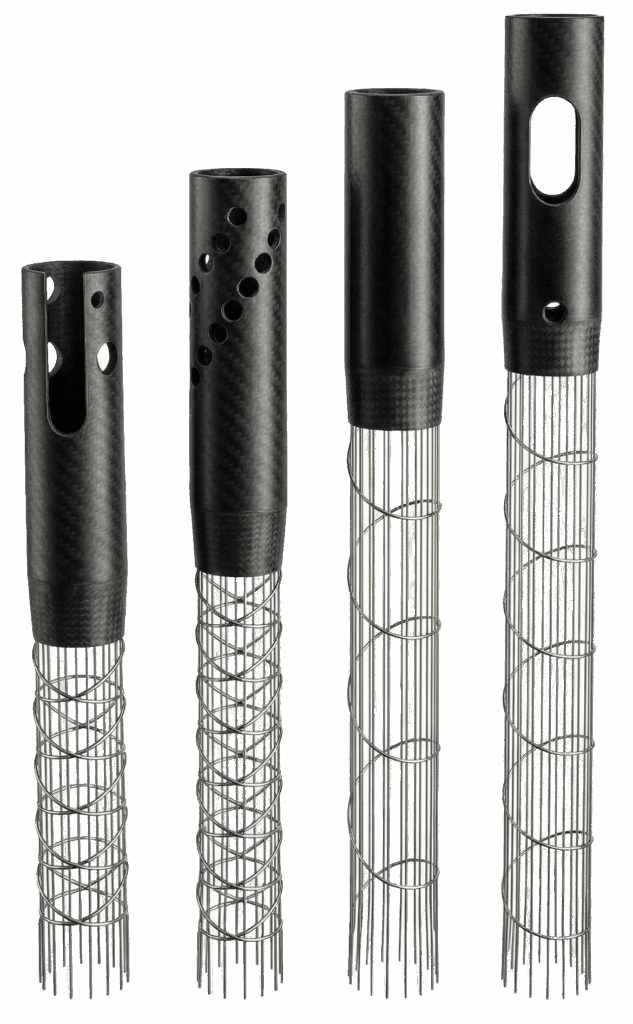
Our composite medical shafts were originally created for laparoscopic procedures in the 1980s. More than 75 million tubes later, they’re the trusted choice in nearly every minimally invasive surgery niche. Polygon’s medical tubing is a customizable mixture of resin and fiberglass—wound, pultruded, or braided into strong, thin forms built to your exact specifications.

Performance
Stronger Than Steel
Unmatched strength-to-weight ratio surpassing stainless steel—rigid for precise cannula placement and resilient for optimal recovery.

Safety
Dielectrically Insulated
Completely dielectric, offering inherent safety from electrical shock.

Customization
Built to Your Specs
Customizable diameters from 1mm to 20mm, with wall thicknesses as thin as 0.254mm.
Why Choose Polygon Medical Composite Shafts?
Design
Stronger & lighter than steel
Dielectrically insulated
Nonconductive & nonmagnetic
Non-reflective optical characteristics
Homogeneous material (insulative all the way through)
No secondary sheathing required
Durable & versatile
Manufacturing
Engineered to order
Thick- or thin-walled applications
Numerous fabrication options
Tested to specifications
Performance
High strength-to-weight ratio
High torsional stability
Autoclavable
Radiolucent & radio-opaque
Corrosion-resistance
Elevated temperature performance
Electromagnetically transparent
MRI compatible
Proven bio-compatibility
ISO 10993 compliant
Proven medical applications
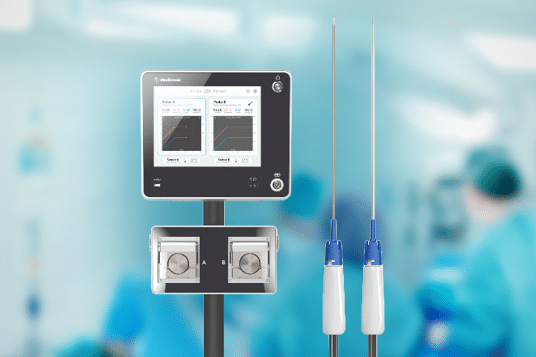
Ablation Surgery
Thermally insulated to safeguard against stray energy during high-stakes procedures.
Key Benefits:
Naturally safe, rigid, and resilient.
Thin-walled shafts for lightweight performance.
100% dielectric, ensuring safety during MRI-guided procedures.

Laparoscopic Surgery
The Original Choice for Laparoscopic Surgery—Trusted by Surgeons Worldwide.
Key Benefits:
Rigid cannula for precise placement.
Made with naturally insulated materials.
Fully customizable for various applications.
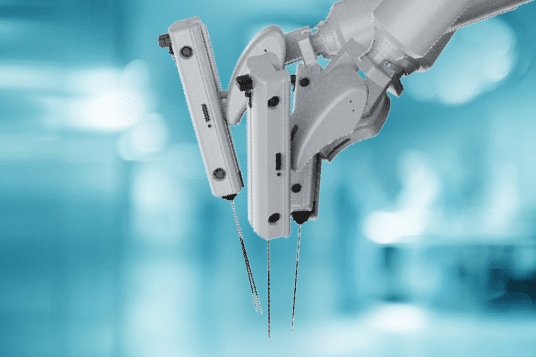
Robotic Surgery
Precision-engineered composite shafts that meet the rigorous demands of robotic systems.
Key Benefits:
High degree of stiffness for confident performance.
Resilient material springs back to original shape.
Naturally insulated for safety.
Your project isn't off-the-shelf.
Neither are our solutions. Tell us what you’re building—our engineers will design a composite shaft for your exact application.
Specifications
Polygon’s Medical Shaft Material (PG-F-6100 & PG-F-6200) Typical Properties
| Tensile Strength | 594 MPa | ASTM D30939 |
| Tensile Modulus | 15.24 GPa | ASTM D30939 |
| Flexural Strength at Break | 0.80% | ASTM D790 |
| Flexural Modulus | 47.7 GPa | ASTM D790 |
| Flexual Stress | 375 GPa | ASTM D790 |
| Dielectric Strength | 400 V/mil | ASTM D149 |
| Linear Coefficient of Thermal Expansion | 4.70 u m/m C | ASTM D696 |
| Thermal Conductivity | 0.620 (W/m-K) | ISO 22007-2 |
| Material Density | 1.68 g/cm3 | ASTM D792 |
Polygon Medical Shaft FAQs
What is Medical Tubing?
Medical tubing is used to connect medical devices and robotics from patient to operator. Polygon initially started medical tubing for laparoscopic prostate procedures in the 1980s when a customer inquiry arrived requiring rigid composite tubing to insert up the urethra. Today, we’re a proven leader in composite medical tubing that withstands the strain of fast starts and provides protection against short-circuits.
How are composite medical tubing products made?
All of Polygon’s medical tubing is made using pultrusion in varied fiber orientations, including unidirectional, circumferential, and braided. The fibers are pulled, wound, and heated simultaneously. For more information on the benefits of each fiber orientation, check out our Medical Design Guide.
What are the most common applications for composite metal tubing products?
Polygon medical tubing is most commonly used in minimally invasive products such as ablation tools, robotic surgery, endoscopic/laparoscopic devices, and suction/irrigation devices. See more in our Medical Design Guide.
Are composite solutions safe to use in a medical application?
Yes! It’s also self-insulating,which protects both patients and operators from risk of shock.
Do you offer product samples for specific applications?
We have medical sample kits so you can hold our materials in your hands and, more importantly, perform any preliminary testing you might need.
How do you test your products and what tests do you recommend before implementing a composite solution?
Our first goal is to make sure we engineer our products to your exact specifications, so that whether we test their performance or you do, they live up to and exceed your standards. If we know the test method you’ll be implementing, we can often mirror it in our facility before delivering the final product to you.
Outside of your specific project, we test our products’ temperature ranges, voltage tolerances, chemical reactions, pressure, and water.
How are Polygon products made?
Depending on the product we’re making, Polygon Composites are made in one of the following ways:
Filament wound: The fibers are dipped in resin, wound around a mandrel, then moved to the ovens to bake.
Braided: The fibers are wound around each other in a braid, and then the whole braid is dipped in resin.
Pultruded: The fibers are pulled, wound, and heated simultaneously.
What information is necessary to know if a composite solution is right for our application?
The more you can tell us, the better. At minimum, we’d like to know where the composite solution will go, what it will do, what environmental factors will be present, and what temperature tolerance, load capacity, and water absorption we need to account for.
Are your composite products pre-made, or is every order custom?
Do you have materials on-hand to fulfill my order?
We keep raw materials on hand but finished stock can depend on the size and specifications of the product. If we help you create a large inventory of bearings and/or tubing for your project, we can often hold it onsite and ship it to you as needed. If you’re curious about lead times, we’re able to meet most lead times–even with a fully customized product. Of course, shipping, logistics, and medical restrictions can always impact the timeline.
How quickly can you produce a composite sample for my specific application?
We often find that creating a custom sample doesn’t offer cost or time savings over creating your actual, customized product. For that reason, we recommend discussing your exact application with our engineers, who can answer virtually any question about what you can change and what performance you can expect.